
What is the bottleneck analysis approach for the management of severe acute malnutrition?
What is the bottleneck analysis approach for the management of severe acute malnutrition?
Action Against Hunger
UNICEF
A range of surveys and tools exist to gain an understanding of a nutritional situation, service delivery performance, bottlenecks and coverage (e.g. MICS/DHS/SMART, coverage assessments [e.g. SQUEAC and SLEAC], routine information and surveillance etc.). Yet currently, severe acute malnutrition (SAM) information systems are not usually designed to routinely indicate bottlenecks (obstacles) to effective service delivery coverage in a structured, logical manner. Tools and approaches are required to support structured identification of bottlenecks, determination of causes and solutions and routine monitoring of corrective actions.
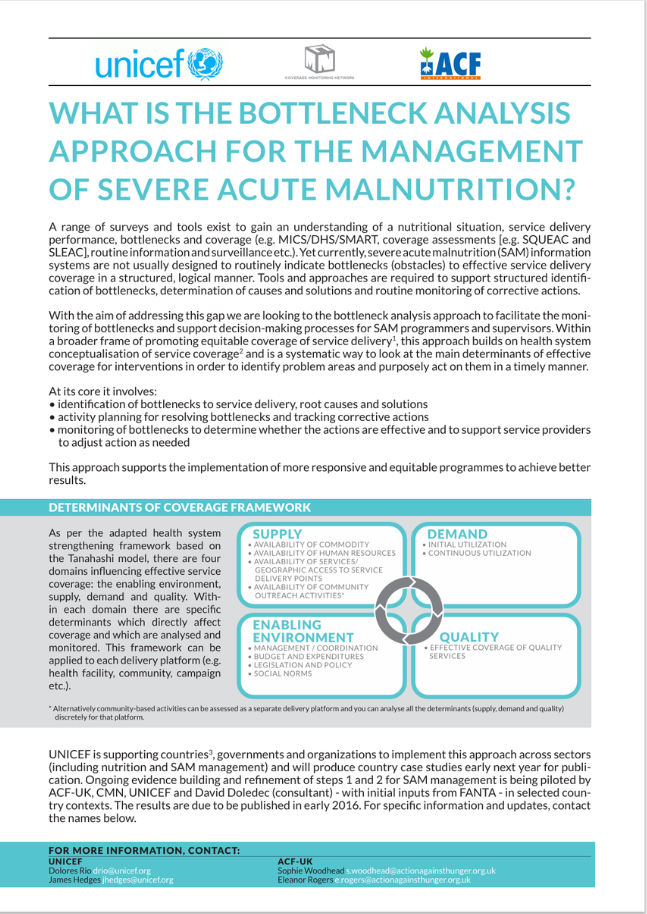
With the aim of addressing this gap we are looking to the bottleneck analysis approach to facilitate the monitoring of bottlenecks and support decision-making processes for SAM programmers and supervisors. Within a broader frame of promoting equitable coverage of service delivery, this approach builds on health system conceptualisation of service coverage2 and is a systematic way to look at the main determinants of effective coverage for interventions in order to identify problem areas and purposely act on them in a timely manner.