
SQUEAC report, Kupang district, Indonesia, Sept 2016
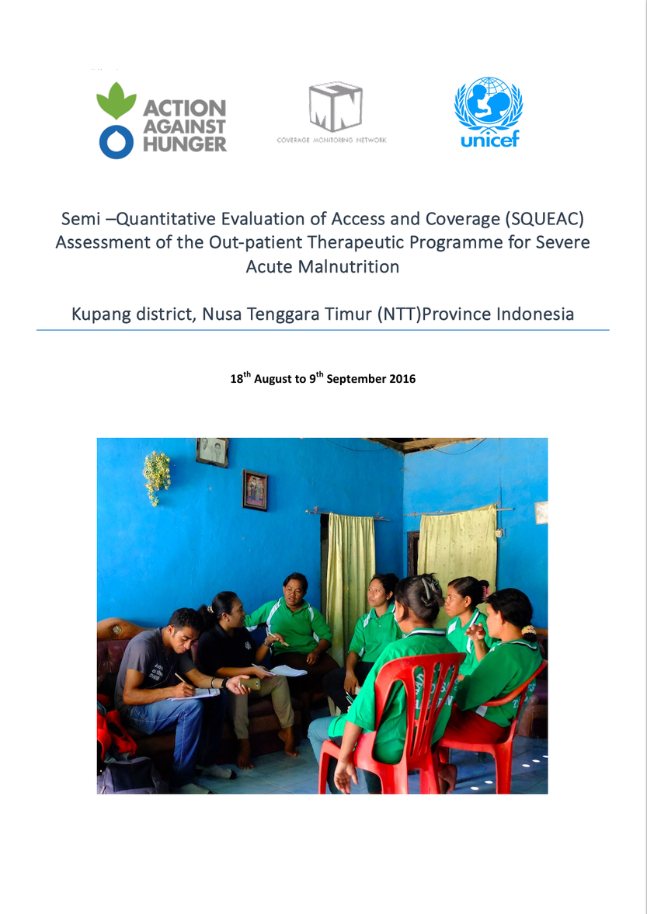
Semi–Quantitative Evaluation of Access and Coverage (SQUEAC) Assessment of the Out-patient Therapeutic Programme for Severe Acute Malnutrition Kupang district, Nusa Tenggara Timur (NTT)Province, Indonesia
9th September 2016
Action Against Hunger
In August 2016, a coverage assessment of services to treat Severe Acute Malnutrition (SAM) was conducted in Kupang district, Nusa Tengarra Timur (NTT) province, Indonesia. The assessment used the SQUEAC (Semi-Quantitative Evaluation of Access and Coverage) methodology and covered services delivered by the Ministry of Health with the technical partnership of Action Contre la Faim (ACF). The assessment identified a single coverage estimate of 25.0% [CI 16.7% – 33.3%] for the outpatient therapeutic programme (OTP).
The quantitative and qualitative data analysis revealed a series of boosters and barriers to access, giving us information on what factors have been positively and negatively influencing coverage. Positive factors included the motivation of community volunteers (Kaders), motivation of health staff to screen and monitor the volunteers and also the fact that the health centre is situated nearby. At health centre level, staff recognised the support provided by ACF for the CMAM programme. Finally, the trust of the families in the programme or health system in general, when aware of its presence, contributed to children accessing services.
Factors that affect coverage negatively (or barriers) were found to be more numerous. Those that were found to have the greatest impact on coverage included the long distances required travelling in order to get to treatment sites and the lack of available transport or the high cost of transport. Rejection of cases for admission into the programme was not found to have a strong impact on coverage.
The community aspect of the programme was found to be very limited. Although there was some screening and referral occurring at community level, sensitisation on health and nutrition was found to be very weak and one of the main barriers. This means that the programme is not raising enough awareness to overcome poor understanding of malnutrition and treatment, which delays admission. The lack of parent’s knowledge about both the programme and malnutrition in general lead to them not considering malnutrition to be a disease. Opportunity cost was high and parents always favoured work and were found to be busy instead of going to the health centre.
At a health centre level, certain aspects were found to be in need of improvement. Tarus area was found to have the same number of health centres as Batakte, while having more than triple the population. This obviously has a direct impact on the time the health staff can spend taking care of SAM children. Motivation of the health staff and volunteers in the field is also an issue, with CMAM not taken seriously up until recently, even by local authorities of the district.