
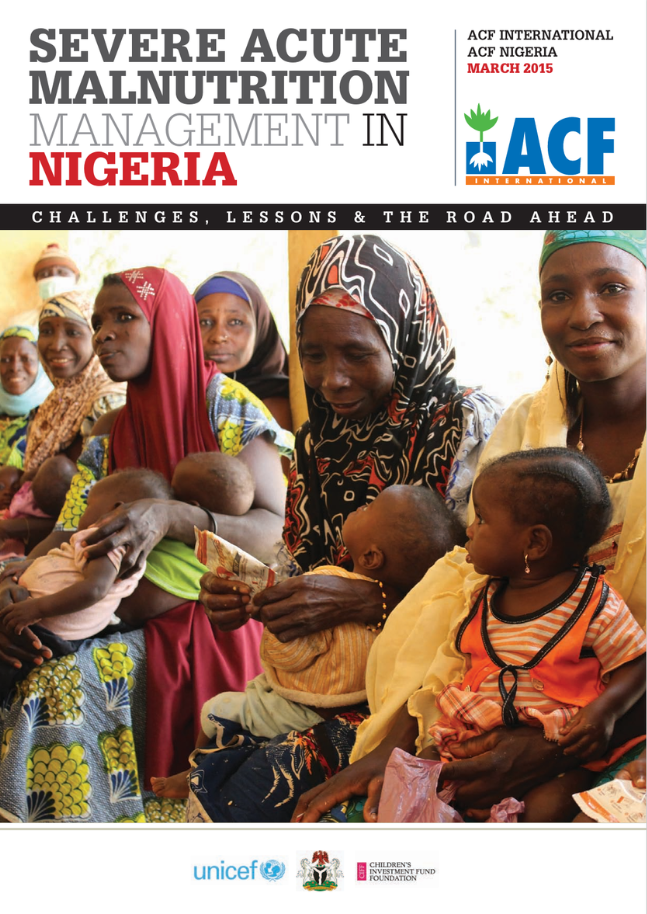
Severe acute malnutrition management in Nigeria
SAM management in Nigeria challenges, lessons and the road ahead
Action Against Hunger
UNICEF, CIFF
Six years after the introduction of community-based management of acute malnutrition (CMAM) in Nigeria, the country is entering a key stage in its fight against severe acute malnutrition (SAM). After an accelerated scale-up process that has seen the roll out of CMAM services across the northern states and the admission of over 1,000,000 SAM cases, sufficient evidence has been generated to analyse the successes, challenges and lessons that must shape the future of SAM management in Nigeria.
This review was carried out by Action Against Hunger (ACF) with the support of the Children’s Investment Fund Foundation (CIFF). Its goal is to help policy makers and practitioners answer some fundamental questions about the scale of the SAM problem in Nigeria, the performance of CMAM services to-date, and its implications for the future of SAM management in Nigeria and beyond.
The review builds on a range of data sources, from information originally reported by local governments and collected by the Ministry of Health (MoH) and UNICEF, to first-hand data collected by ACF, Save the Children and Valid International through direct coverage assessments in the field. The review benefited not only from the recent availability of CMAM coverage information from across northern Nigeria, but also from the ability to invest in data collection to answer some of the questions that emerged during the course of the analysis.
The structure of the review follows a basic line of enquiry focusing on understanding the challenges, reviewing the solutions and extracting the broader implications. The review is thus structured along a series of key, sequential questions
- What is the state of SAM?
- How have treatment services responded to this situation?
- How have these services performed?
- What proportion of SAM cases have services succeeded in reaching?
- Why have some failed to access services? can these challenges be addressed?
- What does it mean for the future of CMAM in Nigeria and beyond?
The aim of structuring the review according to these questions is to not only make the experiences and information more accessible but to acknowledge that the review is one of the many voices of the conversation about SAM management in Nigeria. By consolidating much of the information currently available and generating new information, the review seeks to further the debate and inform future efforts to strengthen and expand CMAM services in the country