
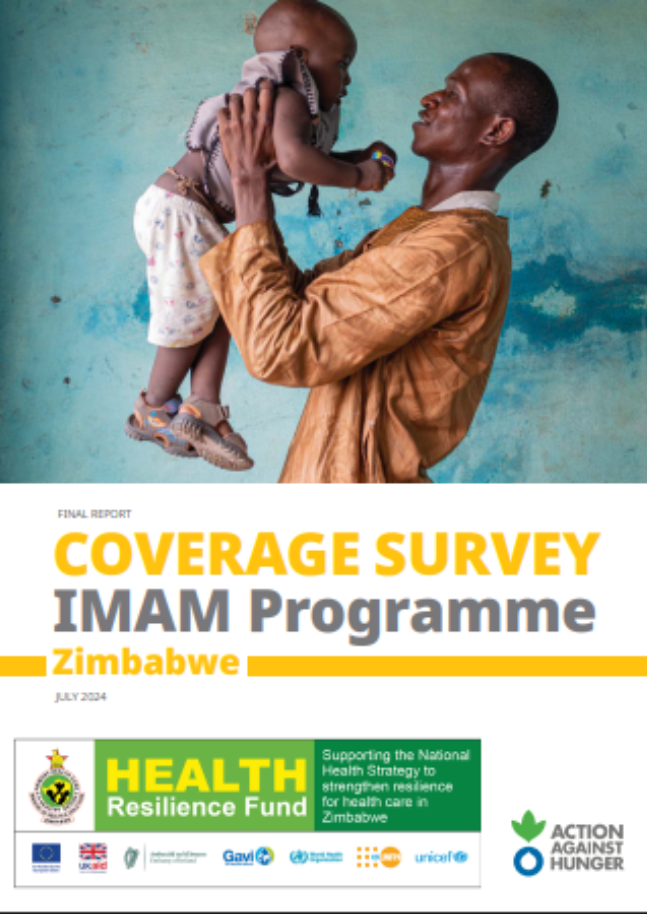
Coverage survey IMAM programme Zimbabwe
The treatment of severe and moderate acute malnutrition is supported by national Integrated Management of Acute Malnutrition (IMAM) guidelines. In 2019, a guidance note was issued to enable the use of RUTF for children with severe and moderate acute malnutrition during emergencies. In 2023, approximately 160,000 children were estimated to suffer from wasting, including an estimated 19,775 children who needed life-saving treatment for severe wasting. Due to a lack of investment for essential nutrition supplies and quality improvement, only 10,556 children with severe wasting were treated, which represented the lowest admission rate recorded over the course of the last 7 years. As information about treatment coverage is scarce, a coverage assessment was deemed necessary to assess the IMAM programme access and to identify the barriers and boosters of access to treatment in Zimbabwe.
1st July 2024
Action Against Hunger
UNICEF, Health Resilience Fund
In Zimbabwe, child undernutrition is a critical public health issue. The country faces a triple burden of malnutrition including under nutrition, over nutrition and micronutrient deficiencies.
More frequent and severe droughts resulting from the climate crisis, the recent COVID-19 pandemic, the HIV epidemic, the economic situation and compromised food system feature among key determinants of increased malnutrition in country.
The treatment of severe and moderate acute malnutrition is supported by national Integrated Management of Acute Malnutrition (IMAM) guidelines. In 2019, a guidance note was issued to enable the use of RUTF for children with severe and moderate acute malnutrition during emergencies. In 2023, approximately 160,000 children were estimated to suffer from wasting, including an estimated 19,775 children who needed life-saving treatment for severe wasting.
Due to a lack of investment for essential nutrition supplies and quality improvement, only 10,556 children with severe wasting were treated, which represented the lowest admission rate recorded over the course of the last 7 years. As information about treatment coverage is
scarce, a coverage assessment was deemed necessary to assess the IMAM programme access and to identify the barriers and boosters of access to treatment in Zimbabwe.
This coverage survey consisted of an analysis of routine programme monitoring data at the level of provinces and/or districts, which was integrated into a bottleneck analysis to identify high and low performing provinces and/or districts. In the second stage, a series of SLEAC surveys was conducted across the selected high and low performing districts to classify coverage, identify key barriers and boosters of access and coverage from the community perspective. In the third stage, an in-depth qualitative inquiry was conducted to further deepen the understanding of identified barriers and boosters in Stage 1 and 2 and to formulate meaningful recommendations adapted to the context.