
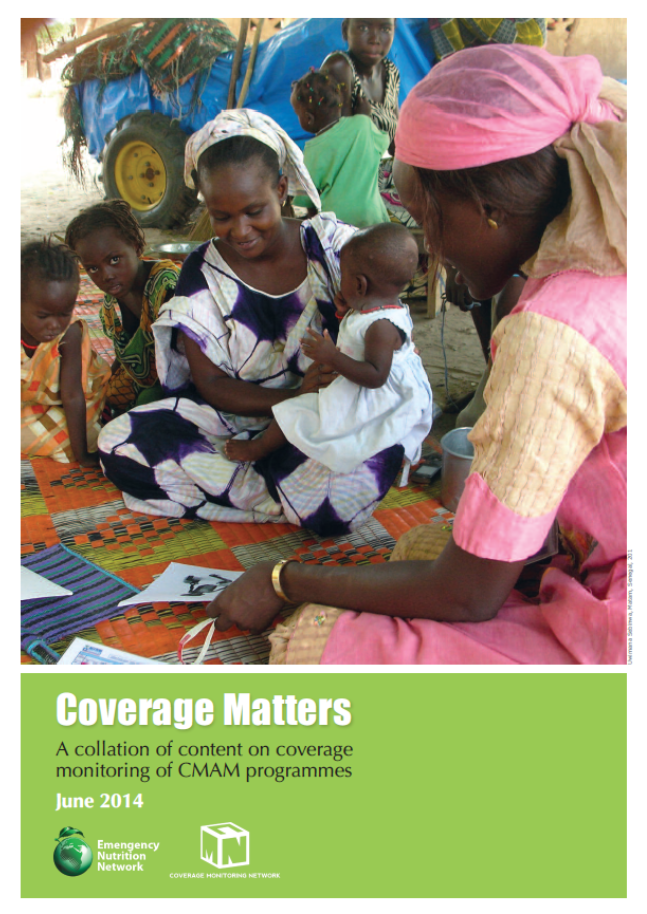
Coverage matters: a collection of content on coverage monitoring of CMAM programmes
This publication presents recent experiences and lessons learned on coverage monitoring and serves as a practical guide for field practitioners.
1st January 2014
Coverage Monitoring Network
Coverage assessments have become integral to many CMAM programmes, either as part of a monitoring strategy or as specific activities in the cycle of the project. Reports, publications, peer-review articles, conferences, workshops and trainings centred on coverage measurement now feature heavily in the nutrition sector. The Emergency Nutrition Network (ENN) team has been involved in many of the discussions about how to achieve and measure coverage and over the past couple of years, ENNs publication, Field Exchange, has contained many articles on coverage. To improve accessibility, key articles published in 2012 and 2013, have been compiled into this special coverage publication, in a collaboration between the ENN and the Coverage Monitoring Network (CMN). The featured articles cover a range of content, from the importance of attaining coverage in measuring the impact of CMAM programmes (page 3) to the need to set up coherent coverage standards (page 5) to passionate but constructive methodological discussions (see section 2 page 14). Many of the methodological innovations described have come about due to limitations of existing coverage tools forcing development adapted to field programmes and easily integrated into regular monitoring activities. Arguably, the most interesting results are those coming from field programmes implementing coverage assessments; the last section
(page 19) collates examples of lessons learned in Chad, Mali, Mauritania and Pakistan, as well as in urban and insecure contexts.
We recognise that there is still a long way to go in measuring coverage. The sector must find ways of incorporating coverage measures into routine nutrition information systems in order to obtain real-time information. More importantly, we have to think beyond the measurement of coverage to designing tools that bring about incremental coverage rates. While we have a lot more to learn it is also true that we have learned a lot. We hope this coverage publication serves as an accessible reminder of recent experiences and lessons learned and as a practical guide for
field practitioners.