
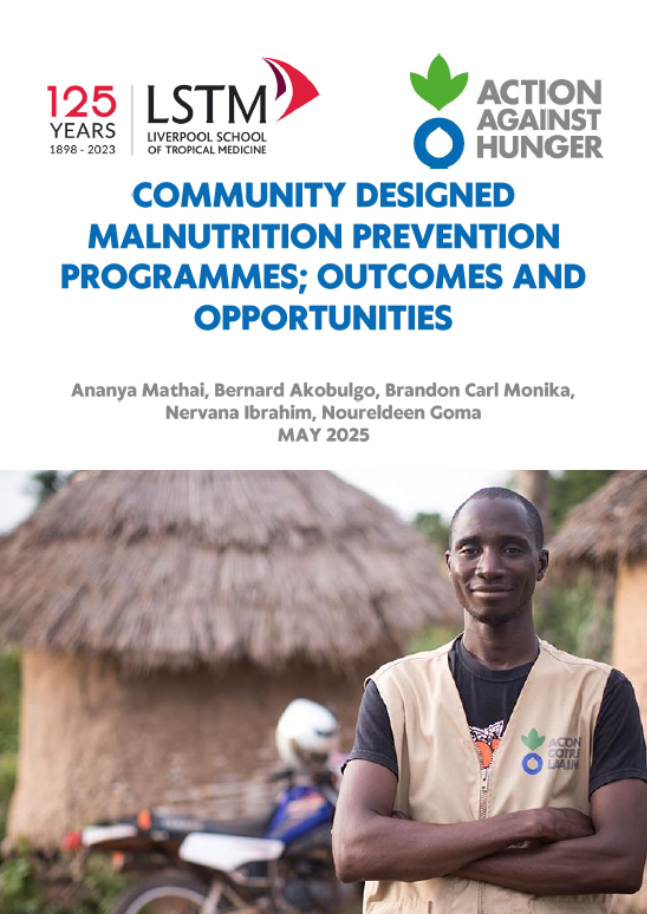
Community designed malnutrition programmes; outcomes and opportunities
This report outlines the findings of a global review on community-designed malnutrition programmes.
1st January 2025
Mathai A. et al.
Liverpool School of Tropical Medicine
Substantial efforts to tackle malnutrition have spanned decades, yet global progress remains fragile and uneven, particularly in regions affected by poverty, conflict and climate change. The report argues that top‑down interventions often lack sustainability when they fail to centre community leadership. Although local ownership is widely acknowledged as important, genuinely community‑led approaches—where communities drive problem identification, decision‑making and implementation—remain rare and poorly documented in nutrition programming. This distinction matters because true empowerment lies at the upper end of the community engagement continuum and is essential for long‑term impact. With growing global commitments to localisation, including by Action Against Hunger, there is an urgent need to examine the forms, outcomes and challenges of community‑led malnutrition prevention programmes so that such models can be elevated within malnutrition and wider disease‑prevention efforts.
The study used a mixed‑methods design combining a targeted literature review and eight semi‑structured key‑informant interviews. From 552 records identified across databases (Scopus, Global Health, Medline and Overton) 15 studies met the inclusion criteria for analysis. Key informants—ranging from nutrition advisers to community mobilisers—were recruited via the Emergency Nutrition Network, client referrals and the researchers’ professional networks; most had direct experience in Asia and/or Africa. Data were analysed inductively to identify recurring themes and insights across diverse programme settings, and the International Association for Public Participation (IAP2) Spectrum was used as a guiding framework to assess degrees of community engagement (inform, consult, involve, collaborate, empower).
The review identified 23 relevant malnutrition programmes targeting children under five, implemented across 16 countries in Sub‑Saharan Africa, Southeast Asia and parts of South and Central Asia. Most programmes were in Sub‑Saharan Africa, more than 60% were multi‑year or ongoing, and stakeholders included communities, local health systems, governments, NGOs and international agencies in resource‑limited or humanitarian settings. Despite frequent references to “community‑based” approaches, only one programme—Senegal’s Boolo Xeex Xibon—was found to be truly community‑designed, a core feature of the community‑led model. While other programmes recorded community participation, actual community leadership in design and decision‑making was generally limited.
Distinguishing preventive from therapeutic programmes proved challenging because lines were often blurred in both design and implementation. Preventive programmes are theoretically best suited to long‑term behaviour change and deeper community involvement, but this potential was rarely realised in practice; many interventions described as preventive relied on communities primarily for delivery rather than for design or decision‑making, positioning them lower on the IAP2 spectrum. Conversely, some therapeutic programmes included community engagement components but frequently in top‑down ways focused on rapid clinical outcomes.
Reported outcomes across programmes were generally positive but tended to differ by programme type. Preventive or high‑participation models reported improvements in qualitative indices—community agency, health‑seeking behaviours and local innovation—whereas therapeutic models emphasised measurable quantitative outputs such as improved anthropometry and recovery rates. Programmes with greater community participation also demonstrated unique value in surfacing culturally specific barriers; for example, participatory sessions in Zambia revealed local taboos that had constrained children’s diets, enabling tailored behaviour‑change strategies that might otherwise have been missed.
Common challenges emerged across the sample, notably funding constraints, socio‑cultural barriers and institutional scepticism. Donor funding cycles and a focus on quantifiable, short‑term results were frequently misaligned with the slower, systemic change required for high levels of community participation. Paradoxically, strong community ownership offered resilience—Senegal’s programme continued to operate effectively despite global funding cuts—yet community‑led models are not entirely insulated from external funding dynamics and still require flexible donor support and capacity investment. Models at the higher end of the IAP2 spectrum also appeared better equipped to navigate internal power imbalances and sociocultural norms; Boolo Xeex Xibon, for instance, empowered women to lead across multiple phases despite operating in a patriarchal context.
In conclusion, community‑led approaches hold transformative potential for sustainability, relevance and resilience in malnutrition prevention, but they remain rare and under‑documented. Many programmes labelled “community‑based” fall short of genuine community design and decision‑making. The authors propose that authentic community leadership—addressing both internal power hierarchies and external donor constraints—must be prioritised if interventions are to move beyond dependency and achieve lasting local impact.