
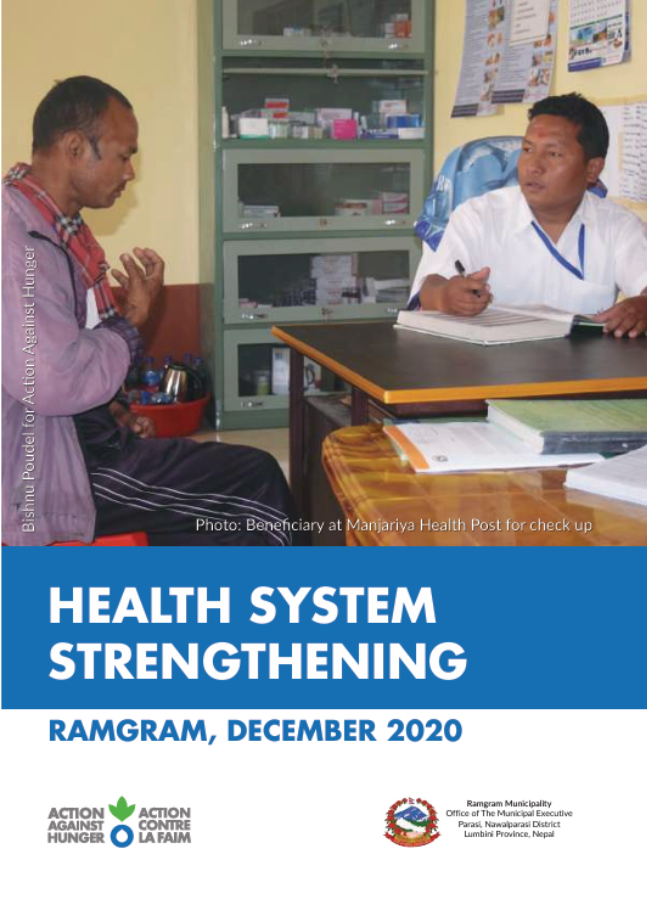
Health system strengthening reports of Ramgram Municipality of Nawalparasi West district
This HSS exercise is first of its kind in the country going below the district and performing at the municipality level with adaptation of the global methodology.
Objective The objective of this Health System Strengthening (HSS) exercise is to establish a solid collaboration with the local health authorities, to jointly get a snapshot of the health system and understand its strengths and weaknesses at the municipality or Palika level, in order to determine the priority actions required for the development of the health system strengthening strategy, that will include building its resilience. This HSS strategy aims at being used by the health authorities from the Palika for the development of their roadmap for the coming years.
1st January 2020
Action Against Hunger
This HSS exercise is first of its kind in the country going below the district and performing at the municipality level with adaptation of the global methodology.
Objective The objective of this Health System Strengthening (HSS) exercise is to establish a solid collaboration with the local health authorities, to jointly get a snapshot of the health system and understand its strengths and weaknesses at the municipality or Palika level, in order to determine the priority actions required for the development of the health system strengthening strategy, that will include building its resilience. This HSS strategy aims at being used by the health authorities from the Palika for the development of their roadmap for the coming years.
Structure of HSS methodology The HSS methodology developed by Action Against Hunger version 3 was used to carry out this exercise under the leadership of the Palika, and in collaboration with all the health stakeholders of the Palika. The exercise in Pratappur Rural Municipality of Nawalparasi West of Bardaghat Susta district was started in June 2019 and ended in December 2020. The exercise took more time than anticipated because of COVID-19 pandemic. The diagnosis phase intends to provide detailed information on strengths and weaknesses of the health system with regards to the WHO six building blocks i.e. Governance, Financing, Service delivery, Health workforce, Supply and Health Information System. The planning phase intends to support the development of comprehensive strategies to reinforce the health system based on the initial diagnosis. In addition, an action plan is prepared in order to enable the Palika health system to prepare, absorb, adapt and transform from shocks.
Five key bottlenecks The HSS exercise outlined 5 key bottlenecks in the Palika which includes:
Lack of sufficient, equitable, need and time based Human Resource at health facilities
- Reports generated from Health Information System (HIS) are incomplete and of poor quality and the information is not properly utilised
- Limited essential health services of the continuum of Reproductive, Maternal, Neonatal and Child Health (RMNCH) services available in the health facilities
- Essential health services of the continuum of Reproductive, Maternal, Neonatal and Child Health (RMNCH) services are not utilised adequately by various levels of the health system
- All essential medicines are not present in all health facilities at all time
The HSS strategy The results of the diagnosis guided the multi-year costed action plan design, which will enable the Palikahealth system to address its bottlenecks and become more resilient to shocks. Under the leadership of thePalika, actors of the health system should be mobilised and integrate the activities into their own action plan in order to take HSS action plan forward.