
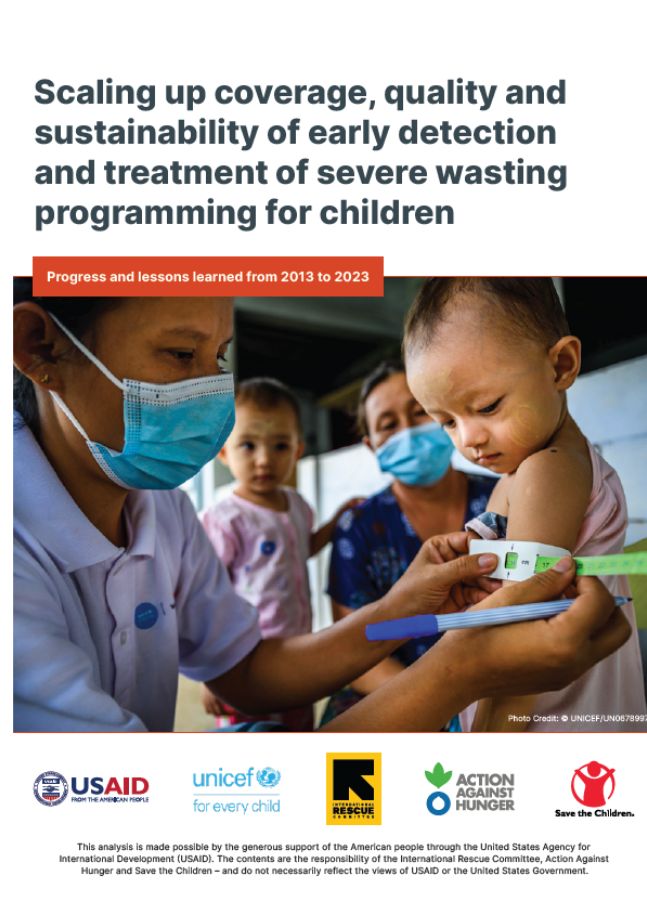
Scaling up coverage, quality and sustainability of early detection and treatment of severe wasting programming for children
This report showcases the progress and lessons learned from 2013 to 2023 on coverage of acute malnutrition.
1st January 2023
UNICEF, IRC, Action Against Hunger, Save the Children
USAID
The analysis drew on UNICEF’s Nutri-Dash data and publicly available nutrition programming data. A thematic retrospective analysis was undertaken of the data, review of peer-reviewed and non-peer reviewed literature, and 32 key informant interviews. The WHO Health System Framework was used to structure findings. Efforts were made to address methodological limitations.
Coverage was defined in relation to the Tanahashi model of health service coverage (e.g. availability, accessibility, acceptability, contact, and effectiveness).
- Treatment coverage referred to the “proportion of identified cases that receive treatment.”
- Geographic coverage referred to the “proportion of health facilities providing treatment programming, or, proportion of subnational administrative units, e.g., districts providing treatment as a share of all units).”
Scale referred to “deliberate efforts to increase the impact of successfully tested health innovations so as to benefit more people and to foster policy and program development on a lasting basis.”
- Horizontal scale referred to operational expansion of interventions and efforts to improve access, demand and quality of care for detection and treatment of severe wasting programming.
- Vertical scale referred to institutionalization and mainstreaming of severe wasting detection and treatment programming within national institutions and structures.
Access and Quality were defined in relation to Sphere Standards.