
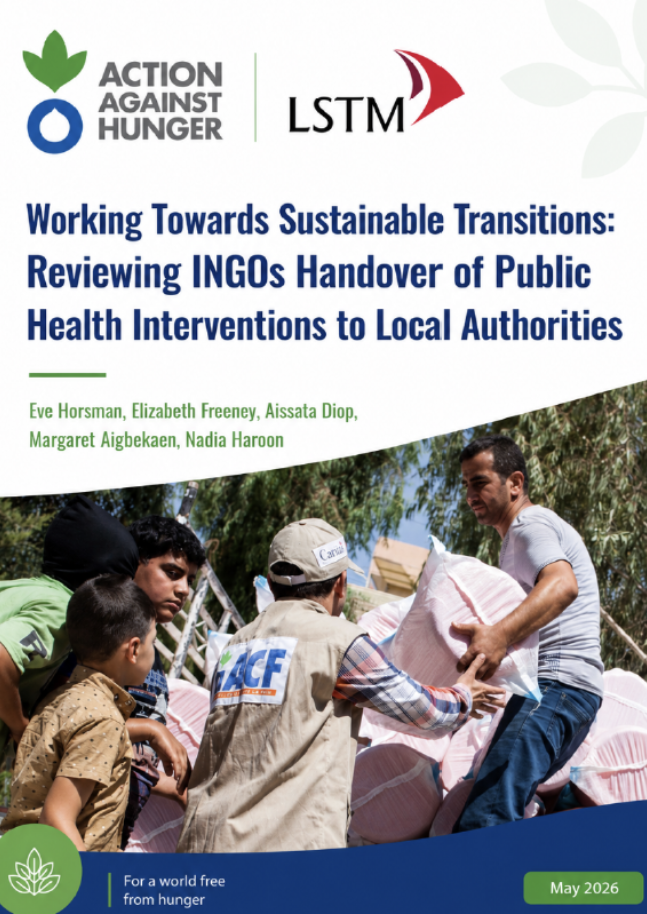
Working on sustainable transitions: reviewing INGOs handover of public health interventions to local authorities
This study examines the enablers and barriers influencing the sustainability of handovers from international NGOs (INGOs) to local organisations
1st May 2026
Eve Horsman, Elizabeth Freeney, Aissa Diop, Margaret Aigbekaen and Nadia Haroon
Liverpool School of Tropical Medicine
Non-governmental organisations (NGOs) play a key role in humanitarian and public health delivery, particularly in fragile contexts where sustainable handovers are essential for long-term impact. Increasing emphasis on localisation and system resilience has meant handover processes are essential to ensuring continuity beyond external support. However, despite strong policy commitments, including the Grant Bargain and Charter for Change, sustainable transition remains difficult to operationalise in practice.
This study examines the enablers and barriers influencing the sustainability of handovers from international NGOs (INGOs) to local organisations. Evidence was synthesised from a structured literature review and semi-structured key informant interviews with practitioners directly involved in handover processes. A hybrid thematic analysis was used to identify patterns across both conceptual and practice-based evidence.
Findings show that sustainable handovers are shaped by a combination of interdependent factors rather than any single intervention. Across the literature and interviews, key enablers included early and embedded exit planning, long-term institutional capacity strengthening, flexible and sustained financing, equitable partnerships, and meaningful community engagement. Where these conditions were aligned, transitions were more likely to result in continued service delivery and local ownership.
However, the study also identifies persistent structural barriers. Short funding cycles, rigid donor requirements, and limited investment in transition phases frequently limited implementation. Power imbalances between INGOs, donors, and local organisations limited meaningful participation in decision-making, while limited post-exit monitoring restricted opportunities for learning. As a result, many handovers were described as reactive and compressed, rather than planned and adaptive processes.
A key finding is the gap between conceptual guidance and operational reality. While the literature promotes principles such as early planning and localisation, practitioner accounts note the constraints that prevent these from being consistently applied. This shows that sustainable handovers are not only technical processes, but are influenced by wider organisational and systemic conditions.
Overall, the findings show that sustainable handovers depend on how planning, capacity, financing, and partnerships work within broader structural conditions. Achieving this needs a shift from viewing handovers as an endpoint to understanding it as a continuous, system-wide process from the start. Without addressing these structural limitations, commitments to localisation and sustainability risk remaining aspirational rather than operational.